Frequently Asked Questions
Getting started
If you have balance on your localbitcoins wallet, you should log in and withdraw your bitcons.
To send Bitcoins from your LocalBitcoins Wallet enter the receiving address and the amount you wish to send and click continue. Please note that you can only withdraw your whole balance at once.
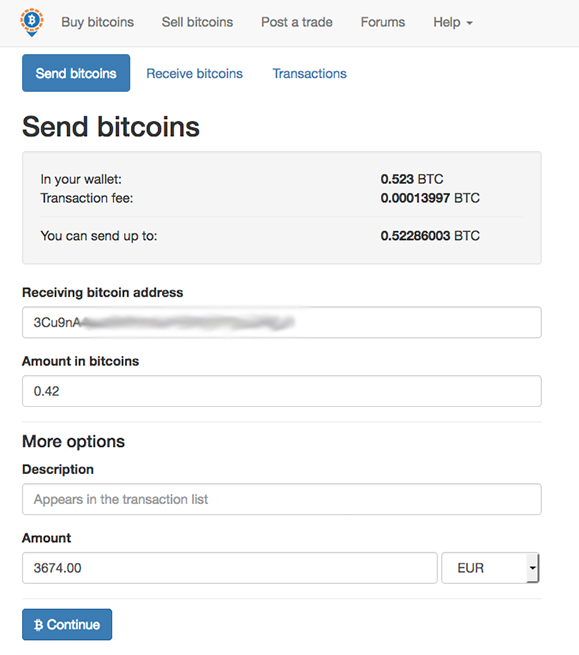
On the following page review the details, and enter your password (and your two-factor authentication code, if you have 2FA enabled) to send the transaction.
Please note that your LocalBitcoins Wallet cannot be used in a few specific situations. For example, you cannot use it with sites like satoshidice that returns Bitcoins to the sending address.
Using LocalBitcoins
The LocalBitcoins website is currently available in English, Spanish, French, Italian, Russian, Brazilian Portuguese and Chinese.
You can change the language of the site from the footer, scroll down all the way to the bottom of the page and click the text next to the globe under the heading Services to see a dropdown of the languages on offer.

- Enable two-factor authentication for your account. This protects you when a someone finds your password. With two-factor authentication enabled, it is not possible to log in to your account if someone knows only your password. Remember to write down the backup codes, preferably on paper, in case you lose your codes.
- Make sure Login guard is enabled. It protects you from logins from unknown web browsers. When Login Guard detects a login from a new web browser it asks you to confirm your browser by clicking a link sent to the email address you have used to register your account. Login Guard is automatically turned on for all new users. Read more about Login Guard
- Remember to use a strong password, one with at least 10 characters. To make it easier to remember difficult passwords we recommend you use a password manager such as KeePass ( ), KeePassX ( / ) or 1Password ( / ).
- Do not use the same password on other websites and do not give your password to other people, even your friends.
- Do not use an email provider that does not require a password, like yopmail, as it makes it possible to access your account without needing to know your password. If you want a secure, anonymous, email use a service such as Tutanota.
With Bitcoins, the owner of the wallet and the Bitcoins is responsible for his/her own security. If your user account is compromised you will lose your Bitcoins, and because Bitcoin transactions are NOT reversible it is not possible for LocalBitcoins to help you get them back. That's why it's very important to follow the security tips given above.
What should I do if someone else has accessed my account?
- Immediately change your password.
- Immediately open up a support ticket explaining what happened and include your account name, the email you used to register on LocalBitcoins, your name, IP address, phone number associated with your account and your recent site activity. You can find out your IP address by searching in Google for "What is my IP?".
Two-factor authentication is enabled from the security settings page. We offer two different types of two-factor authentication, mobile based and paper based. We recommend you use mobile based two-factor authentication and only use paper based if you do not have access to a smartphone.
When activating two-factor authentication it is very important that you write down the backup code and keep it in a safe place, preferably on paper. If you lose access to your two-factor codes you will not be able to log in to your account and it will require a two-factor reset which takes two weeks to process.
Activate mobile based two-factor authentication
- Visit the two-factor activation page and choose I want to use mobile app based two-factor authentication.
- Install the authentication app on your phone. Google Authenticator is available on Android, iOS and Windows Phone. You can find it from the app store.
- On the LocalBitcoins web page, press Proceed to activation.
- Write down the backup code shown on the page and keep it in a safe place, preferably on paper. It's very important that you do this.
- Launch the Google Authenticator app on your smartphone and press Begin Setup.
- Select Scan Barcode from the mobile app.
- If you are asked, allow the application to take pictures and record video. After this you can scan the barcode shown on the LocalBitcoins webpage.
- The 2FA codes will now start appearing in the Google Authenticator app. To complete the setup, take the code from the Google Authenticator application and enter it into the LocalBitcoins website in the box Authentication code, type your password in the Your password field and press Enable two-factor authentication..
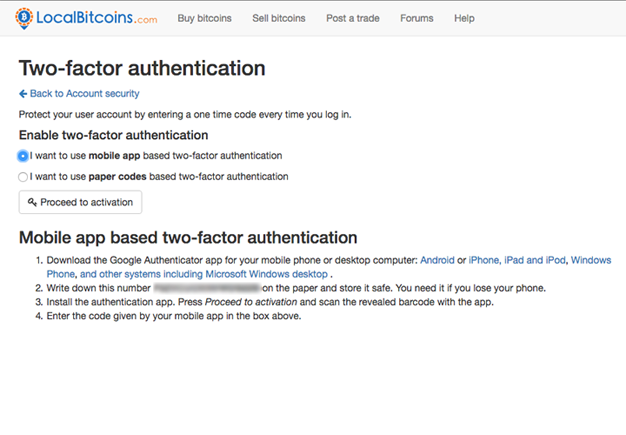
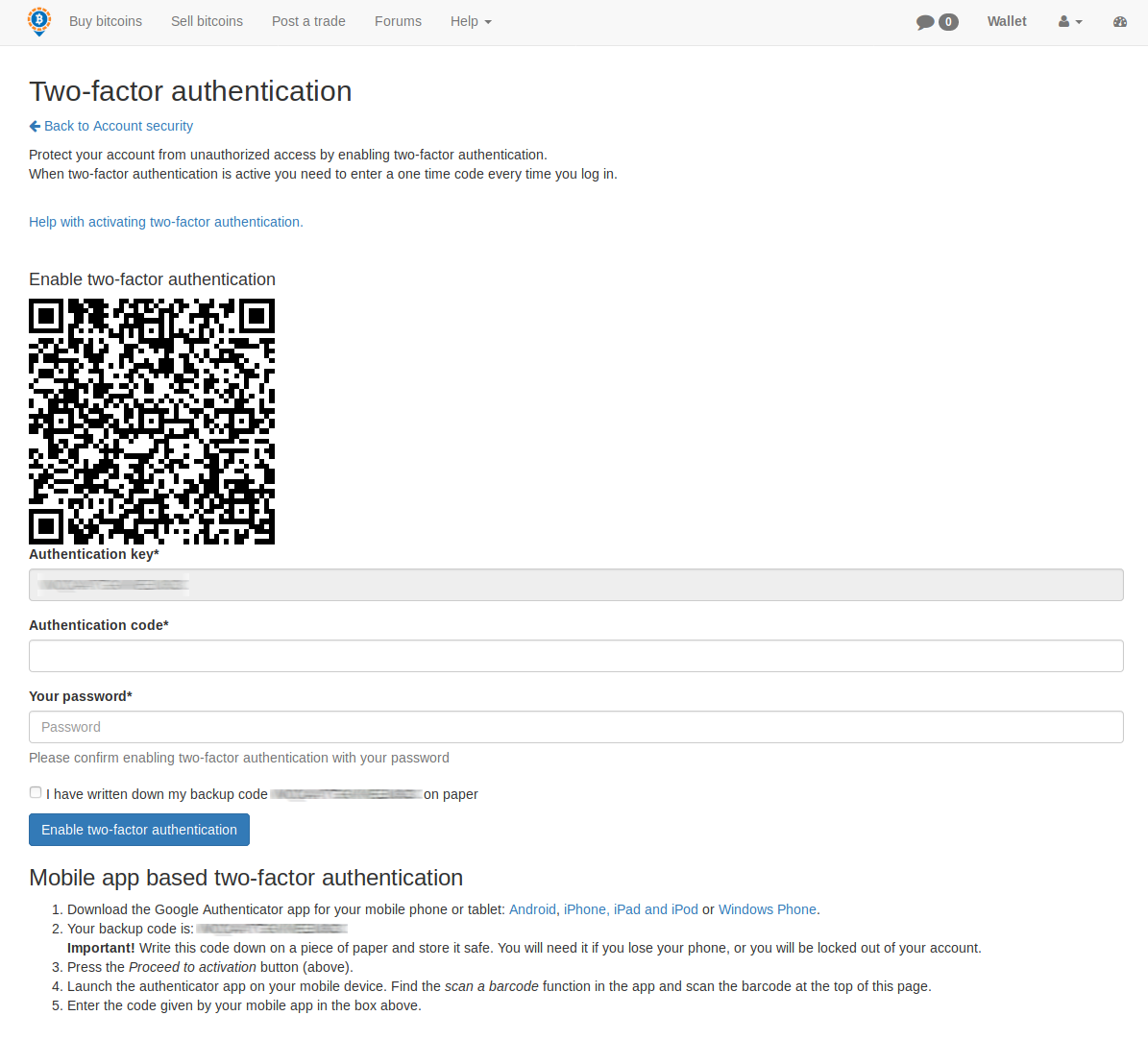
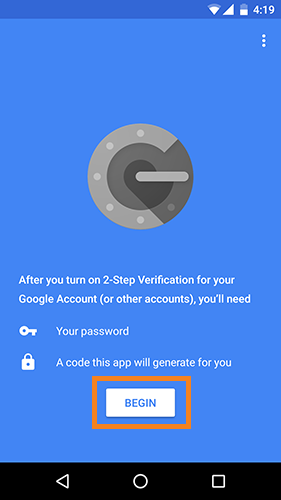
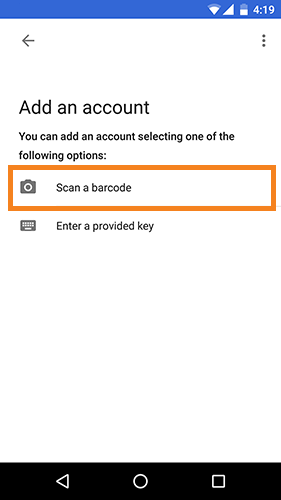
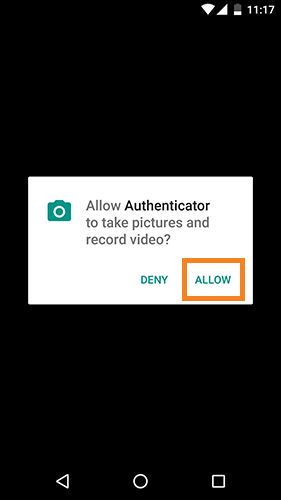
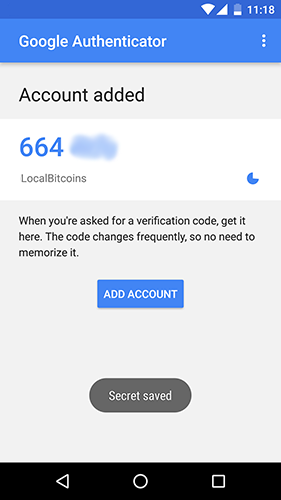
You're now all set and protected by two-factor authentication! Each time you log in to your account you will also be asked for a code that is shown in the authenticator application.
Activate paper based two-factor authentication
- Visit the two-factor activation page and choose I want to use paper codes based two-factor authentication.
- Click the link to open up your two-factor code list.
- Press ctrl + p (cmd + p on mac) on your keyboard to print the code table.
- Press Proceed to activation on the two-factor authentication page and enter the activation key from the top of the paper, the first two-factor authentication code from the table and your password.
You're now all set and protected by paper-based two-factor authentication! Each time you log in to your account you will also be asked for a code, which can be found on the paper.
Once you've used up all your 90 codes from the paper based code table two-factor authentication will be automatically disabled from your account and you will need to activate two-factor authentication again.
Tick the box that says Enable Web notifications and when your browser asks you for permission to show web notifications, press accept. You're now all set and will start receiving web notifications.
You can take a look at all the browsers that are authorized by Login Guard to login to your account from the Authorized Browsers page in the security options. This page lets you revoke access from a browser if you do not recognize it, e.g. because the location is not yours.
If you have trouble getting access to your account using Login Guard you can open up a support ticket to get help.
Withdrawals & fees
We reserve a small amount of Bitcoin from your wallet balance to pay the Bitcoin transaction fee to the Bitcoin network. Each Bitcoin transaction has to pay a small fee to the network to be confirmed no matter from where it's sent. We reserve this fee in advance to prevent your wallet balance from becoming negative. You can find a list of all of our fees on our fees page. Currently it is possible to only withdraw your total balance so that no bitcoins will be left on your wallet after you make the withdrawal.
This is how web wallets operate. You cannot make connections with incoming and outgoing transactions for the same Bitcoin address.
Please note that the same wallet can have multiple incoming addresses. The Bitcoin protocol ensures that Bitcoins are not sent to an address that does not exist, but they can be sent to addresses which are inactive or not controlled by anyone.
Please let us know by opening a ticket to customer support here.
We will then provide instructions on how to withdraw funds.
Since bitcoin trading was suspended on 2023-02-16, you cannot sell bitcoins anymore and withdraw to your bank account. You can only withdraw to your personal bitcoin wallet with one transaction from the Wallet page here. Please note that after 30.12.2024 you are only allowed do withdraw to your own, self hosted bitcoin wallet.
To learn how to send bitcoin from your LocalBitcoins wallet and verify the ownership of the bitcoin address, please read this guide.
There is also a guide for Android devices.
LocalBitcoins automatically blocks transactions to wallet addresses identified as high risk by our security system.
As an example high-risk wallet addresses are associated with:
- Fraudulent trading
- Scamming attempts
- Hacking/Phishing
- Money laundering
- Darkmarkets
- Malware
- Financing of terrorism
Make sure that you are not sending transactions to the aforementioned wallet addresses and that your transactions are in accordance with our Terms of Service.
Now that Localbitcoins.com is not actively operated anymore, it may take up to 2 months before transaction leaves from pending state and is sent to the bitcoin network. Typically the transaction is sent immediately or within 1-2 weeks. After the transaction is actually sent, it is sent with a high priority fee to ensure they confirm within approximately 30 minutes (within the next three blocks).
Bitcoin transactions have to be confirmed by the Bitcoin network before they are usable from the wallet they are sent to. You can read more about confirmations on the Bitcoin Wiki.
To check the status of your Bitcoin transaction
- You need to know the transaction id (TX ID) or the receiving wallet address (looks like: 1JF7RrjBzmVymz3cFeGWA7iVg3y6UXxyg) and the amount of Bitcoins transferred. On LocalBitcoins.com you can get the transaction information from your wallet transaction history page after you have sent the transaction.
- Go to Blockchain Explorer.
- Type in the receiving address or the transactions ID (TXID) into the Search field. Use the Bitcoin amount to quickly identify transactions if the receiving address has several transactions incoming.
- Click the transaction to view more information about it
- Look for where it shows you how many confirmations the transaction has.
If your transaction has...
- ...more than six confirmations: the receiving wallet has received the transaction. Please contact the provider of the wallet if the transaction still does not appear in the receiving wallet.
- ...0-6 confirmations or unconfirmed: the transaction has left the sending wallet and is still under way.
- ...you cannot find the transaction: the transaction never left from the sending wallet. Contact LocalBitcoins customer support team here.
Please note that LocalBitcoins is charging an administrative fee since May 2023. The fee is charged on the last day of the month. More information in our Terms of Service.
If your withdrawal request is already pending, the fee will not be charged.
Common problems & solutions
- Check that email in your user profile is correctly typed.
- Take a peek in your spam folder, the emails you're looking for may be in there.
- Sometimes an email provider may choose to block emails from a certain domain, you can try changing your email address to see if it helps.
- If you're still having problems receiving emails and can't log in to your account you can contact support by clicking here.
You can use your email address instead of your username when you login. Just type it in the username field. If you’ve forgotten both you can open up a support ticket and we can help you with regaining access to your account.
In this case we can change the email address assigned to your account, but it is necessary to verify that you are the account's real owner.
Please go to the support page and submit a ticket with the following information (all that you can remember):
- Your account username
- A new email address
- The registered phone number on your account
- The registered email address on your account
- Your first and last name
We will also require you to complete some additional ID verification steps. Please also send us in the same ticket the following photographs:
- A photograph of you ("Selfie") holding up your ID along with a note containing (handwritten with a pen) your username and today's date.
- A photograph of a recent utility bill with your name, address, and issue date (within 3 months) on it. The utility bill can be electricity bill, gas bill, heating bill, and water bill. Landline bills and bank statements are also accepted
- A photograph of your ID held right next to your computer/mobile phone screen with the whole screen visible (all four corners). The whole screen needs to show this ticket page and browser address bar.
In order to increase our efficiency of problem-solving, please:
- only upload each photograph once.
- make sure all the details in your ID are clear and visible
To re-activate your Two-Factor authentication codes with Google Authenticator you will need the backup code that you wrote down during the activation process.
- Find your Two-factor authentication backup code from when you first activated two-factor authentication.
- Install and launch the Google Authenticator app on your mobile device.
- Press Begin setup.
- Select the option Enter a provided key.
- Enter LocalBitcoins as the account name.
- Enter your Two-factor authentication backup code in the key field.
- Leave the dropdown as Time based.
- Press add to re-activate your Two-factor authentication.
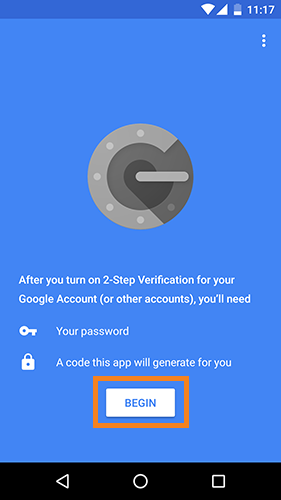
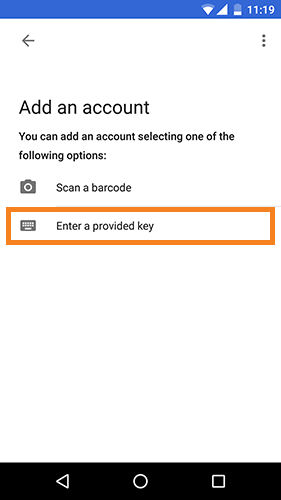
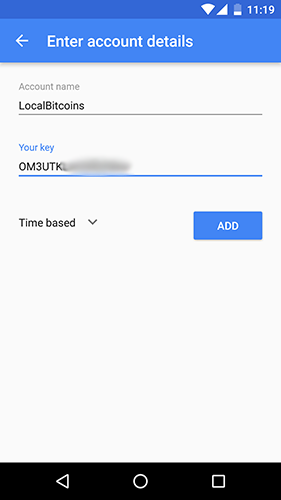
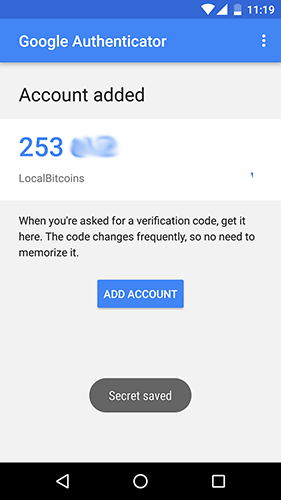
You can now use the code the app displays to authenticate your LocalBitcoins account and log in.
If this did not work, or if you do not have the backup code written down, you cannot re-activate your two-factor authentication and must submit a two-factor authentication removal. You can find a link to submit it while logging in on the page that asks for your two-factor authentication code.
The purpose of two-factor authentication is to prevent unauthorized logins to your account. If you lose access to your two-factor authentication there are two ways to restore access to your account:
- If you used the mobile app based two-factor authentication, you can recover it by using the backup code that you wrote down when enabling two-factor authentication on your account. Please see this guide under the section "How do I re-activate Two-factor authentication using my backup code?"
- If you do not have the backup code, you will need to submit the two-factor authentication removal request from the login page. First, enter your username and password. When the site asks you for your 2FA codes press the "Problems with two-factor login?" link and then the "Send two-factor removal request" button to request the removal of your two-factor authentication. In 14 days you will receive a confirmation email with a link to remove 2FA from your account. The link expires after 48 hours, so make sure you use it as soon as you get it. Please check the spam folder as well. If you set up paper-based two-factor authentication and you don't have access to the codes, you will have to submit the two-factor removal request from the login page. Unfortunately there is no way to recover the codes.
At LocalBitcoins, your security is our priority. We are constantly aiming to keep our platform safe and secure for all our customers. For this reason and according to our Terms of Service, we must request that you complete our Tier 1 Verification process.
Please use this link to verify your identity.
Make sure that the ID document is valid (not expired) and original (not a copy or scan or a photo of the document on paper or screen) is of a good quality and all the information is visible.
After you complete the verification and if you are still unable to withdraw Bitcoins, please let us know by opening a ticket to customer support.
We will then provide instructions on how to withdraw funds.
Personal data
- Dashboard - Your dashboard lets you access your trades and advertisements as well as all related data.
- The support center - You can find all of the support tickets that you've opened through the support center.
- Wallet history - Your complete transaction history can be found from the wallet transactions page.
- Account IP logs - Displays your login history.
- Public profile page - Your public profile contains summarized information of the activity on your account.
- Personal data – You can download various personal data as CSV files here.
If you could not find the data you were looking on the above pages please contact customer support to request a copy of the data that you are interested in.
For data such as your full name or other data that you notice is wrong you can contact customer support and let us know which data you want to correct.
If you would like to erase your data, please delete your LocalBitcoins account here. If you are not able to access your account, you may ask for assistance here.
To the extent that we rely on your consent as a legal basis for processing your personal data, the account deletion request constitutes your withdrawal of the consent.
If you have not used your account for bitcoin transactions or trades we can delete your account immediately. If you have made transactions or started trades we retain most of your data in accordance with our Privacy Policy for a maximum of five years.
For information about the protection of your data and other rights you can read our Privacy Policy.
If you would like to delete your LocalBitcoins account, you can request account deletion here. Account will be deleted after 14 days since the moment you submitted the account deletion request.
If you face issues with account deletion, please contact our customer support team here.
We store data related to your account and transactions due to regulatory obligations for 5 years after the account has been closed.
Please see section 6 in the Privacy Policy for detailed information on data deletion and retention.
In order to delete your account, please click here.
You can access and download your data here.